


Guides and Inspiration
How to Recognize an Authentic Persian Rug: A Practical Guide
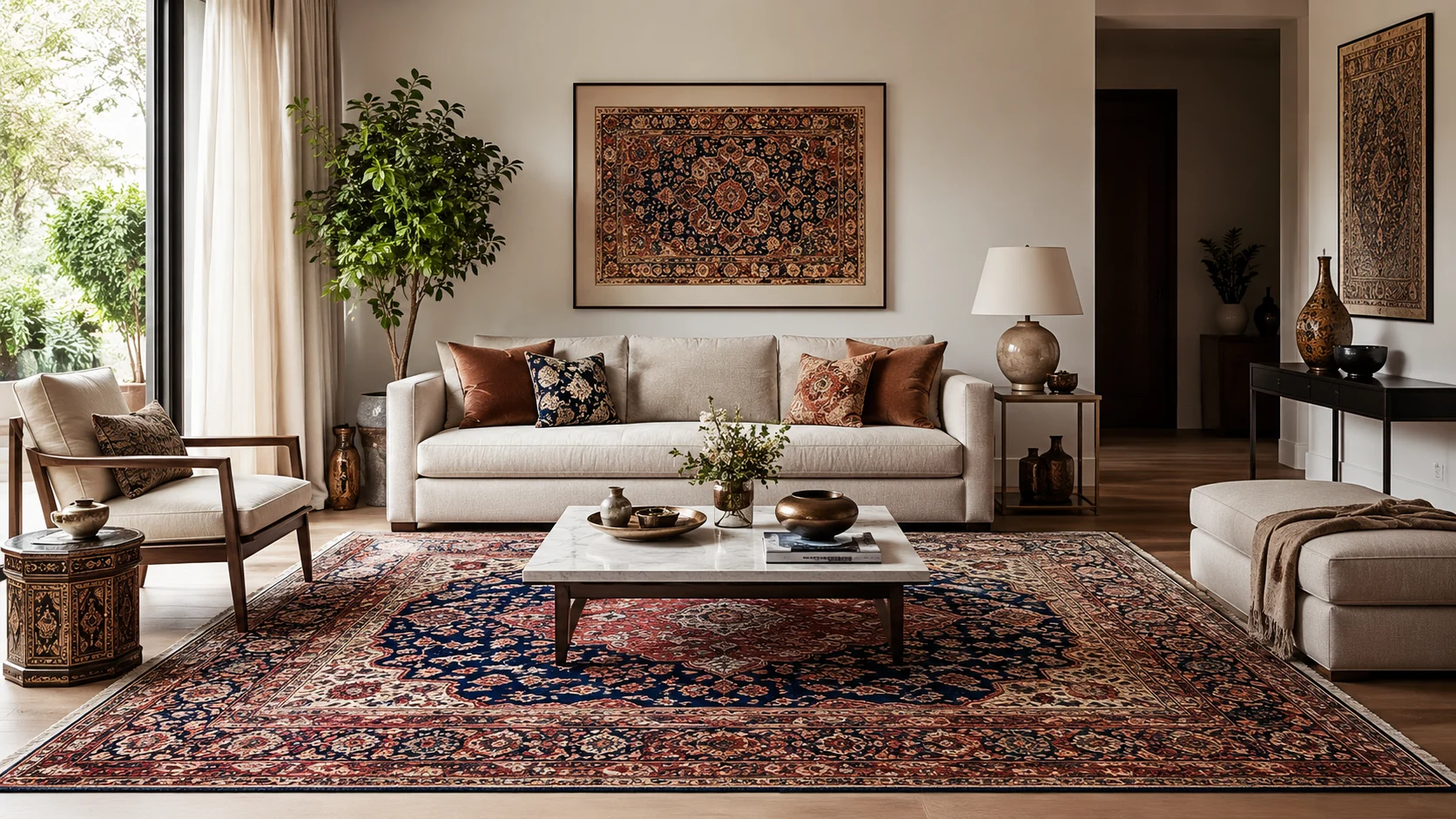
A rug can look Persian without having been made in Iran. If you are trying to understand a particular piece, its pattern is only a starting point. Construction, materials, condition and documented provenance all matter, and no single visual clue can settle the question on its own.
What does “Persian rug” mean?
In the strict geographic sense, the term refers to a rug made in Iran, historically known as Persia. In everyday retail language, “Persian” is also used for designs inspired by that tradition. Ask whether the seller is describing where the rug was made, how it was woven, or simply how it looks.
Look at the construction, not just the design
Turn the rug over and examine a small area in good light. On many hand-knotted rugs, the pattern is visible on the back and the rows may show small variations. These details can be useful clues, but they are not proof: weaving methods differ, and machine-made rugs can reproduce traditional patterns very convincingly.
Take a close look at the edges and ends, too. On many knotted rugs, the fringe continues from the warp, but fringes and selvages can also be repaired or replaced. A sewn edge or an added fringe does not identify the production method by itself. Ask whether the finish is original and whether any restoration has been done.
Materials and colour offer clues, not verdicts
Wool, silk and cotton are common in traditional rugs, used in different combinations for the warp, weft and pile. A soft feel or a particular sheen cannot reliably identify a fibre. Ask for the material details; for a valuable piece, consider an independent assessment.
Colour alone cannot confirm a rug’s age or origin either. Natural and synthetic dyes appear across different periods, and light, wear, washing and restoration can all change a rug’s appearance. If you notice uneven shades, ask the seller to explain them and request clear photographs. A photo rarely tells the whole story.
What can the pattern tell you?
Medallions, floral motifs, geometric forms and layered borders appear across many weaving traditions. Some designs are associated with particular centres, but a pattern by itself cannot prove where a rug was made. Motifs travelled between regions and were reinterpreted over time. If you are curious about flat-woven textiles, see our guide to kilim rugs.
Questions to ask before buying
- What evidence supports the stated country or region of origin?
- What are the exact dimensions, materials and weaving technique?
- Have the edges, fringe, colours or any part of the pattern been repaired?
- Is the stated age an estimate, or is it supported by documentation?
- How was the price assessed, and can the rug be examined independently?
Knot count per centimetre or inch can describe weaving fineness to some extent, but it is not, on its own, a measure of quality, durability or value. Materials, condition, design, repairs and evidence of provenance all matter. For a practical comparison of production methods, read our guide to handmade and machine-made rugs.
A practical check before you decide
Ask for clear photos of the front, back, edges, fringe and any repaired areas. Compare the description with the invoice or other available documents. If the price is high or the rug is presented as especially old, get an independent specialist’s opinion before you commit.
Frequently asked questions
Does seeing the pattern on the back prove a rug is handmade?
No. It can be a clue, but it should be considered alongside the construction, finish, materials and provenance information.
Can I identify the city of origin from the pattern alone?
Some motifs are associated with regional traditions, but resemblance is not enough to confirm where a rug was woven. Other evidence or documentation is needed.
Is every old rug an antique and valuable?
No. Age, authenticity, condition, restoration and market value are different questions and should be assessed separately.
Further reading
- The Metropolitan Museum of Art – Islamic art and carpets
- Victoria and Albert Museum – The Ardabil Carpet
This guide is for general information. For the identification or valuation of a specific rug, consult a qualified specialist.


