


Guides and Inspiration
Romanian and Persian Rugs: What They Share and What Sets Them Apart
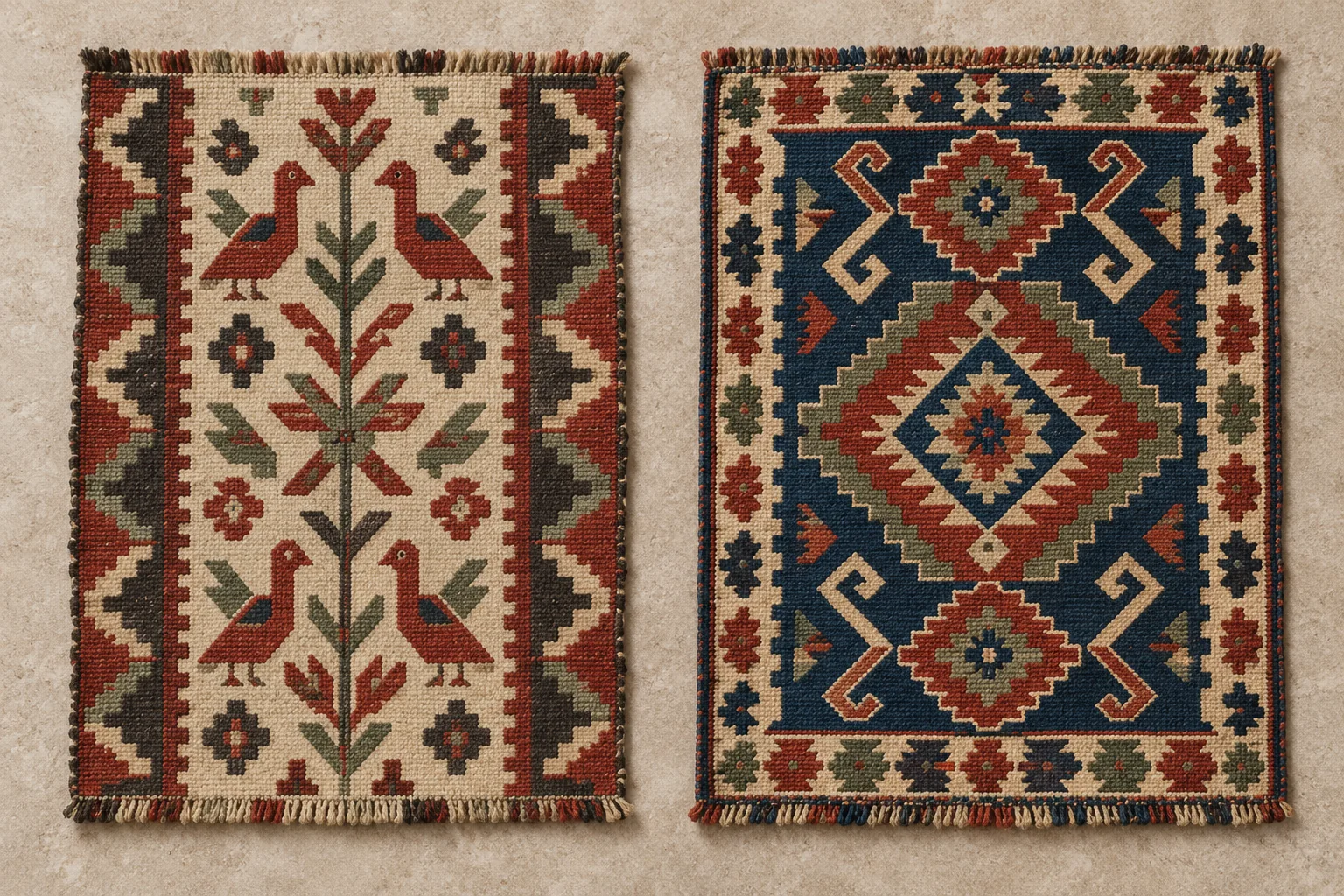
Romanian and Persian rugs can look related at first glance: a Romanian wall rug with diamonds, flowers and repeating borders may bring a kilim or another oriental textile to mind. The resemblance can be meaningful, but it does not identify where a piece was made. Textiles travelled, were admired and reinterpreted; each region also kept its own weaving habits and visual preferences.
In brief: some Romanian rugs incorporated decorative ideas also found in oriental textiles through cultural and trade connections. But a Romanian rug does not become Persian because its design looks familiar. Origin depends on construction, materials, provenance and context—not one shared motif.
First, what do “Romanian rug” and “Persian rug” mean?
In Romania, scoarță often refers to a traditional flatwoven textile used in the home, rather than a pile rug. The National Museum of the Romanian Peasant documents varied techniques and styles from Oltenia, Moldavia, Maramureș, Banat and other regions. Persian weaving includes both hand-knotted pile carpets and flatwoven textiles such as kilims. A fair comparison starts by identifying what kind of object each piece is.
Why do some designs look related?
Motifs did not stop at borders. The National Museum of the Romanian Peasant describes oriental influences reaching Oltenia and Banat through the Balkan world, and Moldavia and Bukovina through communities, monasteries and trade routes. That gives a historical setting for decorative ideas being adopted and adapted. It does not prove that every similar Romanian motif was copied from a Persian rug.
Romanian collections also preserve Iranian carpets that travelled into the region. The National Museum of Art of Romania holds an Isfahan carpet woven in the first half of the seventeenth century and originating from a monastery in Moldavia. Its presence shows that Iranian carpets reached the Romanian Lands; it does not mean locally woven scoarțe were made in Iran.
Motifs that may feel familiar
Diamonds, stylized flowers, branches, medallions and repeating borders appear in more than one textile tradition. Oltenian rugs may combine plants, birds, animals and human figures, sometimes in vertical compositions or successive bands. Persian carpets vary widely by region and period: a central medallion, vegetal arabesque, palmettes or geometric layouts do not define every Persian rug in the same way.
A similar form can be arranged differently and carry a different role. Symbolic readings should therefore be tied to a documented object and community. It is not reliable to assign one universal meaning to every diamond or flower.
An important naming trap: “Transylvanian” carpets were not woven in Romania
There is a historical naming trap, too. Many museum carpets called “Transylvanian” are Anatolian rugs—woven in western Anatolia—that later entered churches in Transylvania and Romania, often as gifts. The Metropolitan Museum of Art explains that the name refers to where these carpets were preserved, not to a Transylvanian weaving centre.
These objects are valuable evidence of how oriental carpets travelled and were collected in Europe. They should not be confused with locally woven Romanian scoarțe or treated as Persian simply because they are “oriental.”
How to compare them without relying on pattern alone
- Construction: identify whether the textile is flatwoven or has knotted pile. “Persian” is not a technique; scoarță and kilim refer to textile categories, and Persian rugs can be either pile or flatwoven.
- Composition: look at how the field and border are arranged, how motifs repeat and how the design fits the format. These are comparative clues, not definitive origin tests.
- Materials and finish: note the fibres, warp, weft, edges and ends. Repairs can alter appearance and should be considered.
- Provenance: look for information about weaving location, dating, records and the object’s history. A retail label or visual resemblance is not a substitute for documentation.
For a valuable piece, photographs of the front, reverse, edges and fringe can help start an assessment, but they do not replace specialist examination. See our guide to recognizing an authentic Persian rug and guide to kilim rugs.
Frequently asked questions
Are Romanian scoarțe copies of Persian carpets?
Not as a general rule. Museum sources describe oriental exchanges and influences alongside a strong local foundation and distinct regional traditions. Influence does not mean wholesale copying.
Does a rug with diamonds or flowers have to be Persian?
No. These forms appear in many traditions. Attribution depends on construction, materials, regional style and provenance.
What are “Transylvanian” carpets in European museums?
The label is used for certain Anatolian carpets preserved in churches and collections in Transylvania and the surrounding region. It chiefly describes their preservation history; it does not prove they were woven there.
Is a Romanian scoarță the same as a Persian kilim?
Not automatically. Both may be flatwoven, but the terms cover different traditions, techniques and contexts. Compare the object itself, not just its label.
Sources and further reading
- National Museum of the Romanian Peasant, Carpets / Scoarțe — collections, techniques, motifs and oriental influences.
- National Museum of Art of Romania, Virtual Gallery of Oriental Art — the Isfahan carpet preserved in Moldavia and Anatolian carpets known as “Transylvanian.”
- The Metropolitan Museum of Art, “Transylvanian” Carpet — an Anatolian carpet associated with its preservation in Romania and Hungary.
- National Institute of Heritage / UNESCO, Traditional wall-carpet craftsmanship in Romania — regional practice and ornament vocabulary.
- National Village Museum “Dimitrie Gusti,” Enduring Motifs: Romanian and Persian Carpets in One Frame — context for the comparative exhibition. Page availability may vary.
Editorial note: This article compares documented traditions and influences without assigning origin from a motif alone. Its paired image is an AI-generated illustration made for this article, not a photograph of a museum object.

